|
DAVID VOORHIS & ASSOCIATES
Data Research, Regulatory & Petroleum Engineering Consulting
|
|
| |
|
|
| |
< Previous Page >.......Page 10.......< Next Page >
|
|
| |
|
|
| |
IV. Petroleum Engineering Consulting Service
Reservoir Fluid PVT Analyses/Simulations
|
|
| |
|
|
| |
| |
Knowledge of the type of reservoir fluid is useful for planning the most efficient development and
depletion of an oil and gas reservoir....Pressure-Volume-Temperature
(PVT) characteristics of a reservoir fluid have an effect on the total recovery of the reservoir fluids....Early in the life of a reservoir, total recovery estimates can
be made that are primarily based on PVT characteristics of the reservoir fluid.....As more production and reservoir data becomes available, the influence of the reservoir permeability characteristics
can be incorporated into more refined petroleum engineering techniques for more accurate methods of predicting
and optimizing future recovery. |
|
| |
|
|
| |
Petroleum Engineers are educated and trained in engineering techniques that recover more hydrocarbons
from a reservoir than what would be recovered under normal or natural pressure depletion (i.e., primary depletion)....Reservoir fluids that tend to provide the greatest opportunity
for improved recovery, through pressure maintenance type operations, are gas condensates, retrograde gas condensates
and volatile oils....These reservoir fluids tend to have
poor liquid (oil) recoveries under primary depletion because much of the hydrocarbon liquid that drops out of solution
during pressure depletion, is left in the reservoir upon abandonment.. |
|
| |
|
|
| |
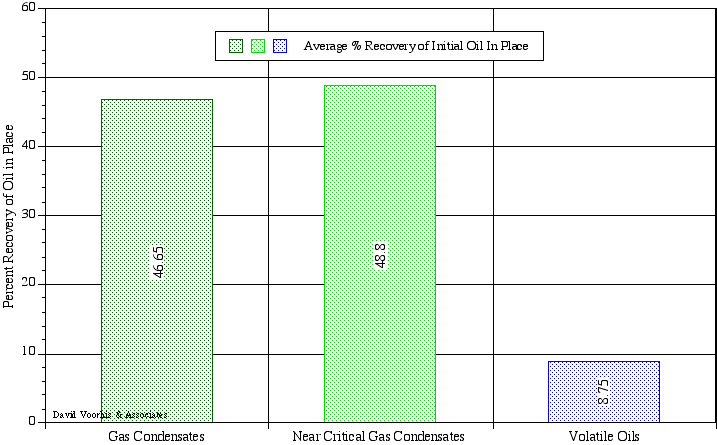
Figure 10.1 provides a comparison of average hydrocarbon liquid recoveries
for gas condensates, retrograde gas condensates and volatile oils....The bar chart recoveries are from a numerical simulation study that used a 2-dimensional, radial numerical
simulator (r-z coordinates, 360°) to model the primary depletion drainage of 40 acres by a single well....The same absolute and relative permeability data was used in the
simulations for all the reservoir fluids considered by the study. |
|
| |
|
|
| |
|
|
| |
|
|
| |
Figure 10.1 : Comparison of Primary Depletion Oil
In Place Recoveries for Gas Condensate, Near Critical Gas Condensate and Volatile Oil Reservoirs
|
|
|
|
| |
|
|
| |
|
|
| |
|
|
| |
| |
Before a simulation study of recoveries can be performed, accurate descriptions of the reservoir
fluids are needed....The most accurate descriptions are
obtained by either recovering a downhole sample or a combined sample from surface production equipment....The fluid samples should be recovered while the reservoir is at
or above the initial saturation pressure of the reservoir fluid....The reservoir fluid sample is then sent to a laboratory for PVT analyses....The most common type of analyses or tests are: Constant Composition Expansion (CCE), Constant Volume Expansion
(CVE) and Differential Liberation (DL) tests....The results
of these laboratory tests are used to create mathematical models of the PVT fluid behavior which are used to model
the fluid behavior in the numerical reservoir simulators. |
|
| |
|
|
| |
Primary depletion process of a reservoir is approximated by the procedures used in CCE and CVE tests....These laboratory tests are important in that they reveal how hydrocarbon
liquid drops out of solution within the reservoir as the reservoir pressure depletes....Reservoirs that have low hydrocarbon liquid recoveries under primary depletion tend to leave a high percentage
of hydrocarbon liquid within the test cell of CCE and CVE tests at the abandonment reservoir pressure....One of the main reasons for low hydrocarbon liquid recovery when
hydrocarbon liquid saturations are high are the relative permeability restrictions caused by liquid accumulation
in the reservoir pore spaces. |
|
| |
|
|
| |
The following 4 figures illustrate the test cell diagrams and hydrocarbon saturation profiles of
Constant Volume Expansion (CVE) and Constant Composition Expansion (CCE) Tests on a range of 8 reservoir fluid
types....The CCE and CVE saturation profiles are from
"tuned" Peng-Robinson Equation Of State (EOS) simulations. The abandonment reservoir pressure for both
tests is usually above 100 psi. |
|
| |
|
|
| |
|
|
| |
|
|
| |
Figure 10.2 : General Diagram of Laboratory Procedure
for Constant Volume Expansion (CVE) Test
|
|
|
|
| |
|
|
| |

|
|
| |
|
|
| |
|
|
| |
|
|
| |
|
|
| |
Figure 10.3 : Profiles of Hydrocarbon Liquid Saturation
vs. Pressure during Constant Volume Expansion (CVE) Tests
|
|
| |
|
|
| |

|
|
| |
|
|
| |
|
|
| |
|
|
| |
Figure 10.4 : General Diagram of Laboratory Procedure
for Constant Composition Expansion (CCE) Test
|
|
| |
|
|
| |

|
|
| |
|
|
| |
|
|
| |
|
|
| |
Figure 10.5 : Profiles of Hydrocarbon Liquid Saturation
vs. Pressure during Constant Composition Expansion (CCE) Tests
|
|
| |
|
|
| |

|
|
| |
|
|
| |
|
|
| |
|
|
| |
| |
Reservoir Fluid PVT Simulations and Analyses are one of many Engineering Studies
that can be performed by David Voorhis & Associates.
|
|
|
|
| |
|
|
| |
Click here to view Contact Information.
< Previous Page >.......Page 10.......< Next Page >
|
|
| |
|
|